Friday, 1 February 2008

Article on the Calstock fort (with images) from the 24 Hour Museum

From the 24 Hour Museum

Archaeologists have discovered a Roman fort in Cornwall – only the third to have been found in the county, making it a rare and exciting find.

It is also intriguing, given that the Romans were thought to have left the region largely to its own devices a few decades after the invasion in AD43. Remains of a furnace and the fort’s location close to a silver mine also suggest the resident occupiers could have been making use of the local mineral deposits.

The fort, in Calstock, south-east Cornwall, was unearthed by a team from the University of Exeter following a geophysical survey. The survey revealed a familiar shape, very similar to the other Roman fort recently discovered in Cornwall at Lostwithiel. On commencing the dig, the instantly recognisable shape of a Roman military ditch confirmed the site as a Roman fort...

Full story here.

Wednesday, 30 January 2008

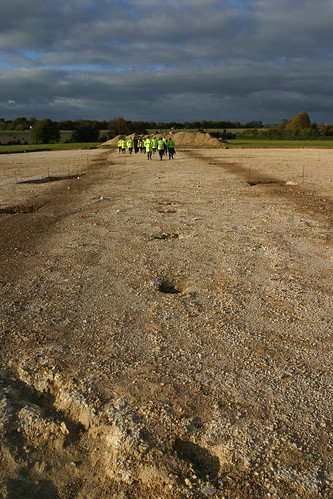
Lovely pic of a Bronze Age droveway from Wessex Archaeology

See more here
Post holes show that this Bronze Age droveway near Old Sarum, Wiltshire, followed the line of a previous boundary or fence.

News of a Roman fort in Cornwall

From This is Plymouth

A previously unknown Roman fort has been found at Calstock in Cornwall, one of only a handful of sites giving evidence of Roman presence in the county, and the first found close to a silver mine.


Archaeologists from the University of Exeter say the site may be evidence the Romans mined tin in the county.

The hill-top site where the first-century fort is in an area known to have been involved with medieval silver mining in the 13th and 14th centuries.

University archaeologists became interested in the site when they found references in medieval documents to the smelting of silver at the old castle and next to the church in Calstock.

A geophysical survey - similar to an underground X-ray - clearly showed the outline of a feature that is a very similar shape to another Roman fort recently found near Lostwithiel, also in Cornwall.

Anglo-Saxon cemetry found in Yorkshire

From The Star

AN ANCIENT burial ground has been unearthed on a South Yorkshire construction site.
Archaeologists have recovered 35 bodies, believed to be Anglo-Saxon, from an ancient cemetery that is thought to date from between the 5th and 9th century AD, when the area was occupied by Saxons and Vikings.

They were found in an area of the new North Ridge Community School in Adwick, Doncaster.

Doncaster Council, the Archaeological Research and Consultancy at the University of Sheffield and South Yorkshire Archaeological Services are working together to investigate the find which if the current age estimates prove to be correct, will be the first cemetery of this period excavated in the whole of South Yorkshire.

ARCUS Project Manager Richard O'Neill said: "It is not everyday that we find something as interesting as this."

When the work is completed the remains will be returned to the council for curation and long-term storage in Doncaster Museum.

Monday, 28 January 2008

Exploration of Renfrewshire's Medieval history

Lectures and field trips explore Renfrewshire's history

DIG IN AND JOIN THE TIME TEAM
By DEREK PARKER
19 January 2008
Paisley Daily Express

BUDDIES who really 'dig' heritage are invited to join Paisley's very own Time Team and make their own little piece of history. Top archaeologist Stephen Clancy is organising a series of lectures and field trips to explore the history of Renfrewshire.

And, just like the heritage hunters of the popular Time Team television series, the local historians will get their archaeological hats on to find out why a Celtic Iron Age community built an enclosure near the site of what is now Braehead Shopping Centre. They will also investigate why monks from Shropshire in the English Midlands were involved in the construction of historic Paisley Abbey.

And the outdoor trips will enable them to get a hands-on understanding of medieval agricultural communities who lived in the hills above Paisley and whose archaeological legacies can still be seen today in the form of drystone walls, ruined farm steadings and sheep enclosures.

"We shall be looking at the history and archaeology of Renfrewshire through the centuries-long development of its landscapes," said professional archaeologist Mr Clancy, who is a former pupil of Paisley's Castlehead High School and has worked at major archaeological projects across Scotland. "The course, which lasts 12 weeks and includes classroom teaching as well as three field trips, takes place at the main Paisley campus of the University of the West of Scotland, where I am a tutor. Renfrewshire is rich in archaeological sites dating from prehistoric times and the course will provide a fascinating opportunity for local people to find out more about the heritage of Paisley and the surrounding towns and villages. There is so much to learn and those who go along will be amazed - and delighted - to discover how much history and heritage there is all around them. Lectures start on Saturday, February 2, and last from 10am till noon, with the field trips also going ahead on Saturdays."

Mr Clancy, who works jointly for two firms based in Edinburgh and London, is at present exploring archaeological sites on the route of the M74 motorway on the outskirts of Glasgow. Previously, he helped to excavate 18th and 19th century skeletons in Kilbarchan West Church burial ground following the collapse of a boundary wall. He also dated architectural foundations at the former Craigends estate, near Linwood.

The cost of the course - A Practical Introduction to Renfrewshire Local History, Archaeology and Heritage - is £25, although some students may be entitled to concessions under the university's Winning Women and Motivated Men project. Ring the university's Centre for Lifelong Learning on 0141 848 3193, quoting reference number COMB 1008, for further information. Alternatively, visit the website at lifelonglearning@uws.ac.uk

'Artful codger' to be sentenced

From the Blackpool Gazette

A Bolton pensioner who fooled the art world for years by selling fake antiques his son had "knocked up" in his garden shed is due to be sentenced.
"Artful codger" George Greenhalgh, 84, would turn up in his wheelchair at art houses and museums claiming to have found or inherited the objects.

Greenhalgh's son, Shaun, faked the objects using art and history books, working from the family's modest terraced home.

Earlier this month George Greenhalgh was told a younger man would go to prison for such dishonesty.

The judge adjourned the case to make inquiries with the Prison Service to see if any jails would be able to actually take and "humanely" imprison a wheelchair-bound pensioner in poor health.

Greenhalgh admits conspiracy to defraud art institutions and money laundering between June 1989 and March last year.
Shaun Greenhalgh, 47, was jailed for four years and eight months last November, while Mr Greenhalgh's wife, Olive, 83, was given a suspended jail term of 12 months after pleading guilty to the same offences.

The family made at least £850,000 through their cottage industry, using the ruse to fool art experts for almost 18 years.

Their biggest success was managing to convince the local council-owned Bolton Museum to part with £440,000 for the Princess Amarna statuette.

The 20-inch piece was authenticated by the Egyptology department at Christie's and the British Museum as 3,300 years old and purportedly a figurine of the daughter of Pharaoh Akhenaten and Queen Nefertiti, the mother of King Tutankhamun. In fact it had been made by Shaun Greenhalgh in his shed over a three-week period.

Iron Age man leaves museum 'home'

From BBC News

The remains of an Iron Age man found in a peat bog are leaving the British Museum for the first time in 17 years.

Lindow Man was found in a Cheshire marsh in 1984, nearly 2,000 years after his horrific death.

Chemicals in the bog preserved the body and researchers found his throat was slit and he was garrotted, possibly as a sacrificial victim.

Lindow Man is being moved from London to the Manchester Museum, on long-term loan, and will be displayed from April.

He was found on Lindow Moss near Wilmslow and is the best preserved body of its era in the UK.

Study of the remains by scientists has improved knowledge of Iron Age activities and made it possible to see the face of a person from the prehistoric past.

Last meal

The man, who died when he was about 25, has a distinctive furrowed brow with close-cropped hair and a beard.

Scientists discovered his last meal was a piece of unleavened bread.

He has been on display in the Manchester Museum twice before, in 1987 and 1991.

Lindow Man will be exhibited in a specially-designed space as part of the British Museum's Partnership scheme, which enables people from around the UK to see its collection.

Neil MacGregor, director of the British Museum, said: "It is a major undertaking to transport Lindow Man to Manchester for obvious conservation reasons, but I am delighted that people in the north-west of England will once again have the opportunity to meet this everyman of pre-historic Britain at the Manchester Museum."